I originally wrote this in 2016 and never got around to finishing it and publishing it. Having read it, I think it still has relevance, and early intervention and action with vulnerable students and their parents/carers is still an essential part of helping those young people to succeed.
Rita Pierson
I was really taken with this video, it was shown to our whole staff at the beginning of the year. I found it really inspirational and made me reflect on my own teaching over the last 30 years and question whether I had always been a champion for children!
The other aspect of this that I found interesting was that it reflected discussions that some of us (teachers and support staff) were having about why our year 11 in the previous year had such positive attitudes to school reflected in; students turning up to revision sessions in unprecedented numbers and an almost complete absence of poor behaviour referrals. Groups of students that had potential to be difficult, and had lacked motivation, had poor attendance or poor behaviour for learning during year 9 had become more involved and happier learners by the time they got into Year 11.
This made me think about what work we had put in with these young people over time that had an impact!
Importantly it reflected how much we had been able to work with many of the young people on a very individual basis, central to that was getting them to feel valued and cared for by the school as well as by individual teachers, the school had invested in their belief in them but that the institution had invested believe in them.
One clear indicator of impact was that the school achieved 100% 5A* to G for the first time and in two of the three core subjects we had a significant increase to over 80% A* to C grades where nationally these subjects showed a decrease.
We carried out a relatively simple program where we paid for a number of students to go to the gym at lunchtime one of our brilliant young PE staff took them and made sure that they got the appropriate training in how to use the gym equipment. In return, the students were each paired with a year 7 reluctant reader and did 2 sessions of paired reading with the year 7 each week. We thought it was important for these young people to get the proper training to be able to confidently do the paired reading, and all of the identified year 11 students attended the training session. I wish I could say that this process was a smooth and faultless process, but it had logistical issues and took a while to get running smoothly, but everyone involved, including the students, agreed that it was worthwhile. It also had a benefit we had not considered in the planning that students had positives to write about in their college applications.
All of these young people went on to Sixth Form, college courses, or an apprenticeship.
Could we have identified these young people in year 7 or year 8? did they exhibit behaviours that would have flagged them up as a cause for concern? poor attendance? off task behaviour ? challenging behaviour? I think the answer is almost certainly yes.
Our KS2 to KS3 Transition work is really very good. The most vulnerable are identified with the primary schools early in the process. A lot of this work is undertaken by our excellent academic counsellors who work with the SENCO to organise all kinds of support groups, behaviour groups, peer friendship support, as well as the more obvious academic support for any student who as not met the KS2 4b threshold who will all be invited to summer school. All of these students (60 last year) are individually visited at their primary school. Students with statements or the new Education Health and Care Plan have the opportunity to be involved in a short film that is then shown to the whole staff where they talk about their expectations for Secondary School and what they hope to get from their teachers.
I am sure that our systems for dealing with vulnerable young people identified at that early stage are excellent, and we make sure that these young people are provided with support, genuine care, and educational challenges. So what about these young people who go on to be a problem in years 10 and 11? I suspect they are the young people who perhaps are more difficult to identify early on. These young people could come from the group who fail to thrive either because they haven’t really grasped what school is about or struggle with the move to a very big and complex organisation, they may not be seen as a problem as they tend to be quiet and not a formal cause for concern they just don’t commit to their work or life in school in the way that we would want from a successful learner although I suspect that by year 9 they are becoming difficult but never to a degree where they suffer sanctions they don’t hit the thresholds for attendance or behaviour but never the less are a concern.
These young people will generally get through KS3 without too much of a problem they may even be close to their minimum target grade but the quality of learning that they have experienced will have developed such poor learning behaviours that the step into GCSE with the expectations around classwork and homework become suddenly very difficult for them.
Slowly, the difficulty with work becomes a refusal to do work or work is completed to a standard well below the level they are expected to achieve and relationships with their classroom teachers become more challenging and time consuming. This breakdown in relationship with school is often in my experience mirrored by an increasingly difficult relationship with their parents, who question increasingly frequent contact from their child’s teacher complaining about lack of work and homework.
Sometimes, the relationship between the school and the parent/s becomes increasingly difficult as well because the parent doesn’t understand what has suddenly gone wrong with the school.
I am sure that many colleagues reading this (assuming someone does) will recognise the scenarios above and have a picture or the name of a child in their head who immediately springs to mind.
There are areas that we could develop further, and one of these is corporate parenting. For most teachers, the sight of young people having the commitment to go around talking to their teachers without their parents or another adult is both moving and frustrating. The fact that the young person sees the importance of the event and being represented at it is both fantastic and moving. The frustration emerges in that the parent or carer is not present. It may well be that there are really good reasons why the guardian might not be present, and this absence doesn’t reflect a lack of engagement with their child’s education, but too often, this is the case.
We have, of course, all the support processes to get parents involved, liaison workers, text messages, and home visits, but there are always those for whatever reason refuse. This has often left all concerned with the young person deeply worried about the support that they receive in the home and the impact of this in school.
It’s at this point that we need to take radical action in school and offer the young person a corporate parent another adult that the young person knows who will support their learning and progress. The best form tutors and heads of year will already be trying to fulfil this role, but too often, we are dependent on an individual response rather than a strategic and coordinated one.
We need to follow the example of some inner city project schools in Chicago where communities have been blighted by a lack of aspiration and role models, and this has been reflected in schools as well. To help combat this lack of aspiration and positive role models, every child has a nominated mentor who is there to support them throughout their school lives. The initial role of the mentor is to provide challenging aspirations as raising the aspirations of young people and their parents is seen as an essential first step to future educational success.
Category Archives: Education

Attendance and Mental Health Part 1
Having been responsible for attendance, pastoral and Safeguarding for more or less my last ten years as a Deputy Head in a very large Community Secondary School, I became increasingly aware of the links between Mental Health and school attendance even in pre-pandemic times. I would go as far as saying that nearly all of the young people who were registered as persistent absent from year 7 to Yr 13 were absent because either they or their carer was struggling with their mental health.
This begs the question of how schools respond to sometimes complex and challenging circumstances. (The slightly controversial element here is that the parents/carers may well be receiving help from adult mental health services, but they are unlikely to let the school know even where it is severely impacting on the children)
I am describing some of the practice we have used that has successfully worked in getting young people back into regular school attendance.
The start of all our pastoral concerns work is our multidisciplinary team meeting that we call Student Support Network Meetings, I’ve no doubt most of you will have something similar in place. This meeting has become an essential part of our intervention’s strategy. The Team meeting is chaired by the Pastoral Deputy or a substitute and the team is the relevant Head of Year, Sendco, Counsellors, The School Attendance Officer, Mental Health Lead and if your lucky enough to have one the School Social Worker and any attached agencies like Youth Support Teams and when relevant the Designated Teacher for LAC either because they want to raise a concern or one of their students is being discussed. The team meets fortnightly for every year team. Having a senior manager running these meetings served a number of functions
1. Provides continuity of process across all year teams.
2. Ensures that the meeting is focused on the students causing concern and keeps a balanced overview of students’ needs.
3. Heads of year are able to focus on the concerns being raised in a supportive environment.
It is the HOYs meeting to raise concerns about students and where they have concerns about the quality and effectiveness of any support that identified students may already be receiving.
We have a very big sixth form, so the Director of Sixth would chair the meeting for year 12 and year 13, and it might also include the academic mentor or other specialist 6th form staff.
Students are discussed in our network meetings because they have been raised as a concern:
- Academic concerns around progress
- Referrals from staff because of wellbeing concerns
- Referral from HOY around failure to thrive, friendships, lack of academic progress, concerns from parents/carers.
- External reports or concerns around a young person (police, social care, housing, CAMHS)
- A catch all phrase failure to thrive, those young people who
- Referral from the Attendance Officer, Form Tutor, Head of Year about a young person’s attendance either because of Persistent Abscence below 90% or concerning patterns of attendance. (Missing on Fridays and Mondays or other regular days)
The team meeting will triage those young people not already known and identify action for someone to carry out.
For learning concerns or failure to thrive referrals, the SENDCO would be asked to get one of her team to carry out an initial screening of the young person. The result of the screening would come back to the meeting for a decision around action to be taken.
For wellbeing concerns, one of the Pastoral counsellors would be allocated to pick up the young person and have an initial conversation with them. They would then recommend further action,
Transition to big school
This is a short piece brought about by my daughter in leaving year 6 of her primary school. The school and students put on a lovely leaving assembly that was a great celebration.
This got me thinking about my own journey from Primary to Secondary school in the 60s in North London. On the odd occasion I talk about this time people generally view my descriptions of Barnsbury Boys Secondary modern with a degree of disbelief.
My Primary School was by modern standards appalling and by the standards of the time I suspect average. I failed the 11 plus it was the last year it happened in what was to become the ILEA. I couldn’t go to the Grammar School but three schools were going to be amalgamated into a new comprehensive called Highbury Grove. one of these schools was Barnsbury Boys.
so I went to Barnsbury Boys lower school a Victorian building in a side street called Eden Grove off Holloway Road, it was an appalling place where learning and education were in short supply, a struggle for both students and teachers. What wasn’t in short supply was violence. The school was run by a group of what we would now call year 9 students with the tacit approval of the Deputy Head in charge of the site. This gang ran the school with a sense of discipline enforced through appalling acts of violence and the payment of protection fees. The students enforced their rule through casual and organised violence.
Their favourite organised violence was called run rabbit run, this required the person to be punished to run down the length of the old outside toilets while being kicked by gang members in each stall. The punishment for falling over was to have your head pushed into the toilet and for it to be flushed. You could also be required to pay double dues.
I would like to think that The Deputy Head Harry was not fully aware of the violence and punishment being dished out to particularly younger students by his protégés who he called prefects but honestly I believe he knew fully what was going on. After one beating I went home and my appalled parents brought me to school the following day to ask this Deputy Head to explain why I had been assaulted by a couple of these prefects on my way home (casual violence). Harry waffled on about how it was all a misunderstanding and how younger boys had to be aware that older students with a position needed to be respected and he would talk to the boys that had assaulted me to find out what had happened (seemed obvious to me I had been beaten up) the crowning point of the meeting was Harry offering to set up the boxing ring so that we could have a fair fight. ( I was 11 and both the boys that had attacked me were 14 so I wasn’t sure how this could be fair). Fortunately my father also thought this was a dreadful suggestion and said that he might be forced to take action if something like that were to happen.
In the end the bullying stopped because one of my neighbours sons found out about it and intervened on my behalf and warned the boys off. In some ways the violence of the students was more considered than the violence by the staff who seemed to slipper students on a whim.
We had one science teacher who would randomly beat students on the backside with a plimsol, this was so random we would take it in turn to wind him up at the beginning of the lesson and get the beating over with rather than sitting dreading it happening.
On another occasion after a metal work lesson in the hut in the playground I was surprised to see the teacher lock one of the year 9 students in over lunchtime. The reason for this became clear part way through lunch when a gang of other year 9 students came and kicked in the door. They then dragged the boy in hiding out into the playground and gave him a really violent beating I kept thinking “where were the teachers” the staffroom looked down on to the playground.
Writing this I still have a sense of disbelief the whole story could be revisited to a Prison where the corrupt lazy governor lets the inmates run the jail or an army camp where the commanding officer lets the NCO’s run the camp by bullying violence and intimidation but this was my year 7 in secondary school.
There were some good teachers who tried hard to teach and instil some sense of value in learning but these good people we’re let down by dreadfully inadequate leadership.
The following year I went to the newly opened Highbury Grove School where Rhodes Boyson was the Headteacher.
My beautiful clever daughter will not experience the lack of care and expectation that I and many others experienced at the age of 11.
The new comprehensive schools rescued many young people from the poverty of experience that was the standard in a lot of Secondary Modern Schools. The early days of many comprehensive were a struggle like many new schools today the new ‘ were an amalgamation of other schools who brought with them a mixture of staff who in turn had a mixture of beliefs, abilities many of them hugely unsatisfactory. So it took time for these new schools to develop their own identity and again it needed strong leaders to make these new schools work.
For those that still doubt my story telling I came across a website dedicated to the school with many stories from former pupils that all echo my own experience.
http://barnsburyboys.weebly.com/teachers—roger-osborn.html
As a teacher for more than 30 years I hope that I have contributed in some way to making sure that the experiences I had as an 11-year-old are not experienced by children today. Please read another part of my blog Caring Teaching for an idea of how we manage the transition to BIG school.
Curriculum Planning as a CPD Opportunity
2 China (there and back again)
Chinese Bridge for UK Schools is a project organised through the SSAT and the Confucius Institute headquarters, known as Hanban is the official Chinese organisation for the promotion of Chinese Language and Culture around the world.
The Confucius Institute helps provide teaching resources and Chinese volunteer teachers to encourage schools to teach the Chinese language. Many of these already exist in different parts of the UK across all phases of education.
About 70 teachers covering all education sectors from HE to Early Years went on the trip to Beijing before the group split into two with one going to Jinan in Shandong Province and the other going to Hangzhou in Zhejiang Province.
Spending time in Beijing was quite an experience we stayed in a hotel near Beijing Zoo and its metro station.


This was our base for 3 days giving us the opportunity to visit the great tourist attractions The Great Wall, The Forbidden City, Tienanmen Square,

As I have said in another blog I feel very privileged to have been able to visit China in this really exciting point in its very long and dramatic history.
Beijing is an incredible city one of the worlds biggest cities genuinely a megalopolis.

We were incredibly well looked after and the majority of us felt that our clothes were a bit tighter after 10 days of being very well fed.
Some of us went to Jinan the city of 100 springs and known as the friendly city, it is the provincial capital of Shandong Province about 450 Kilometres from Beijing. The whole group were very excited by the prospect of travelling on the Bullet train at speeds of around 300 KPH

- Bullet train to Jinan

- Baotu Spring

The city has like many areas of China undergone rapid modernisation and while it doesn’t have the mega sky scrapers of some of the cities, it does have the modern steel and glass hotels and a shopping centre to rival Westfield. 
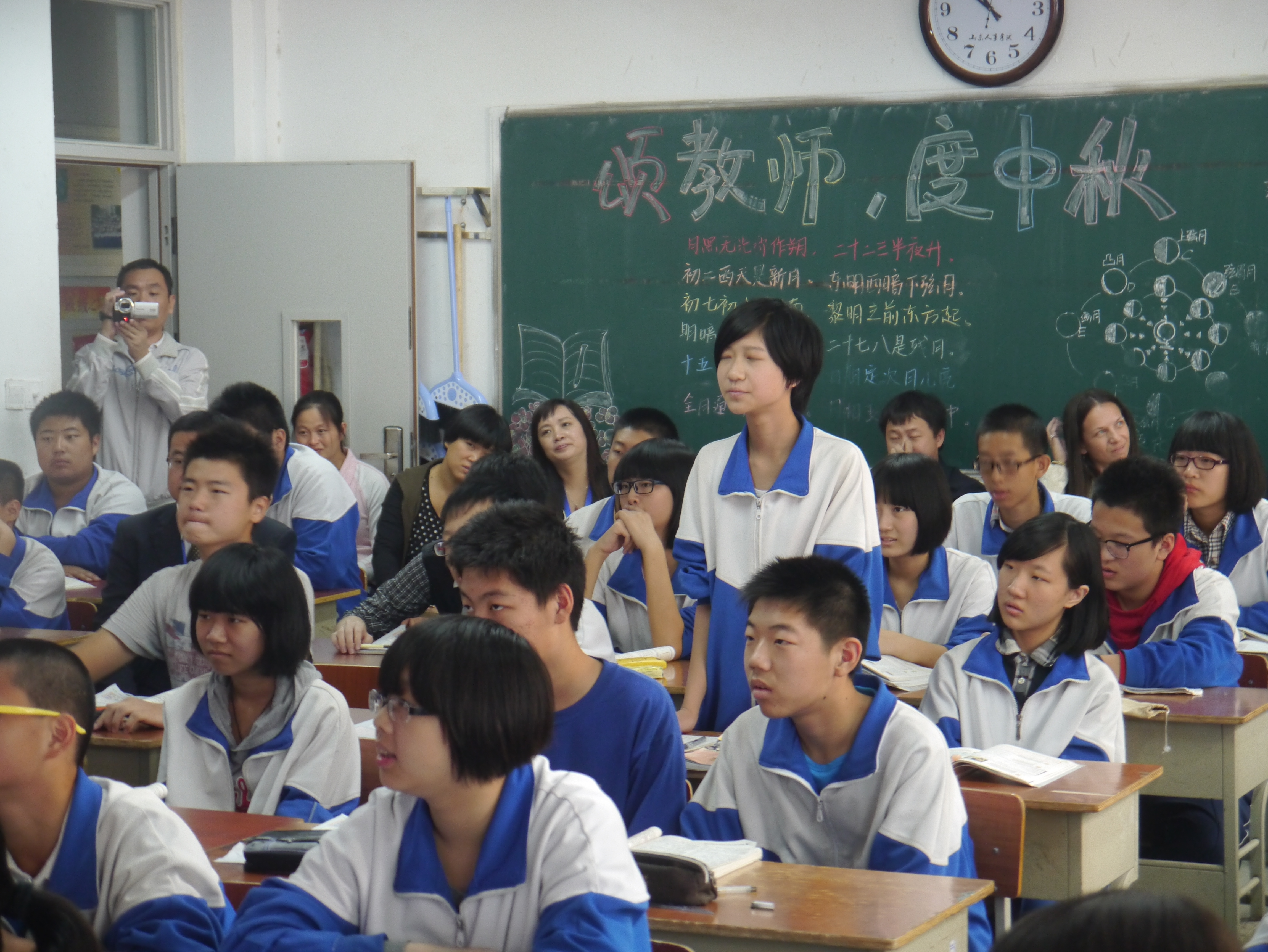
 The school we visited in Jinan was the Jinan Shungeng Middle School, the school has 1800 students aged between 13 and 15.

Itis a local school and non-selective, it has a reputation as a good school and many of its students score well enough in their exams to get into the very selective High Schools. An indication of the popularity of the school is very similar to London in that apartment prices in the area close to the school are more expensive than similar apartments outside the catchment.
The school day starts formally at 7.50am and many students will be in school from 7.30 when it opens, many students will go and see teachers to hand in homework at this time. Lessons start at 8.00am and go on until 12.00am, each lesson is 50 minutes long,with a ten minute break between lessons when students are encouraged to get fresh air, the beginning and end of lessons were announced by playing music over the tannoy system. There is a morning break of 25 minutes when students are encouraged to exercise and play games in the playground. Lunch is two hours and at Jinan Shungeng Middle School all children go home to lunch. Although they can stay on site if they want, to do Homework or make use of the Sports Ground.
Classes start again at 2pm and go on until 4pm but students stay in school until 6pm because they will do extra curricular activities and have team practices and clubs.
Students are all expected to complete 3 hours homework a night and many students will not get to bed before 1am depending on how much homework they have to do. The driving force for this massive work load is in getting the grades required to get into the best high schools that will in turn get them into the best universities either locally in Jinan or moving away to Beijing or Shanghai.
Exams have been central to Chinese education for more than 2000 years as they were an essential part of progression into the imperial civil service.
The school places great emphasis on improving and developing its teachers and teaching staff in the school have won many awards at provincial and national level. Certainly in the 2 days we spent in the school we were aware of lots of peer observations going on with teachers sitting in each others classrooms. Observation seems to be a key element in their teacher development programme. We saw lessons that even with current OFSTED gradings would have been Good or Outstanding particularly a maths lesson were a younger group of students were challenged and put through their paces at a fairly challenging level, which more knowledgeable colleagues said would have been equivalent to higher tier GCSE. The quality and style of teaching has to consider that teachers are working with classes of about 50 students and the science lab we saw was set up for about 70 students
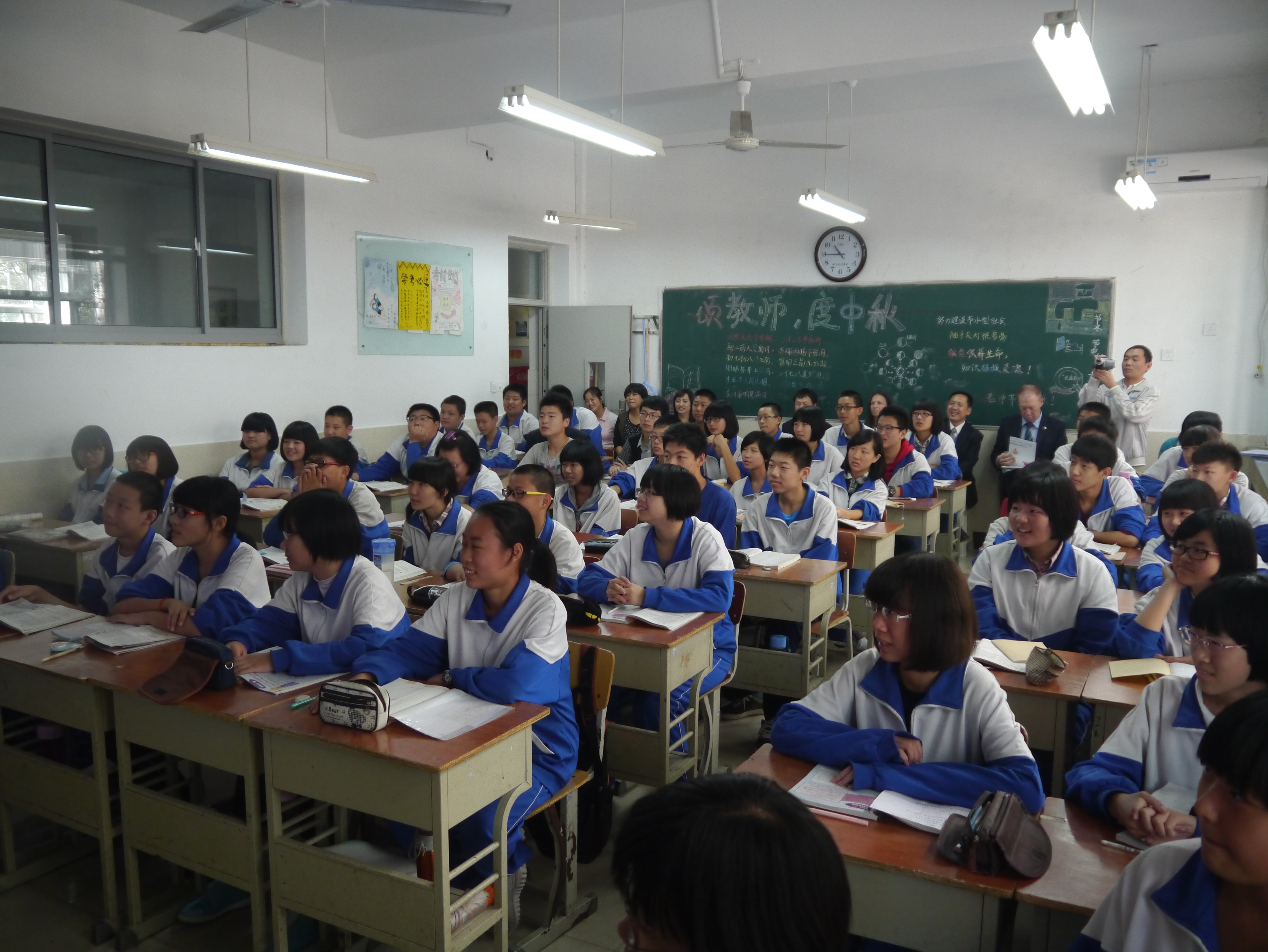
Students have a very long day at school and they work very hard but it was lovely to see that they also played very hard, we saw many students having fun, laughing and enjoying themselves in school but as soon as the teacher walked into the lesson attention on the lesson was 100%. Having said that the relationships between teachers and students in the lessons also seemed to be really good, students and teachers were not afraid of having a laugh together.
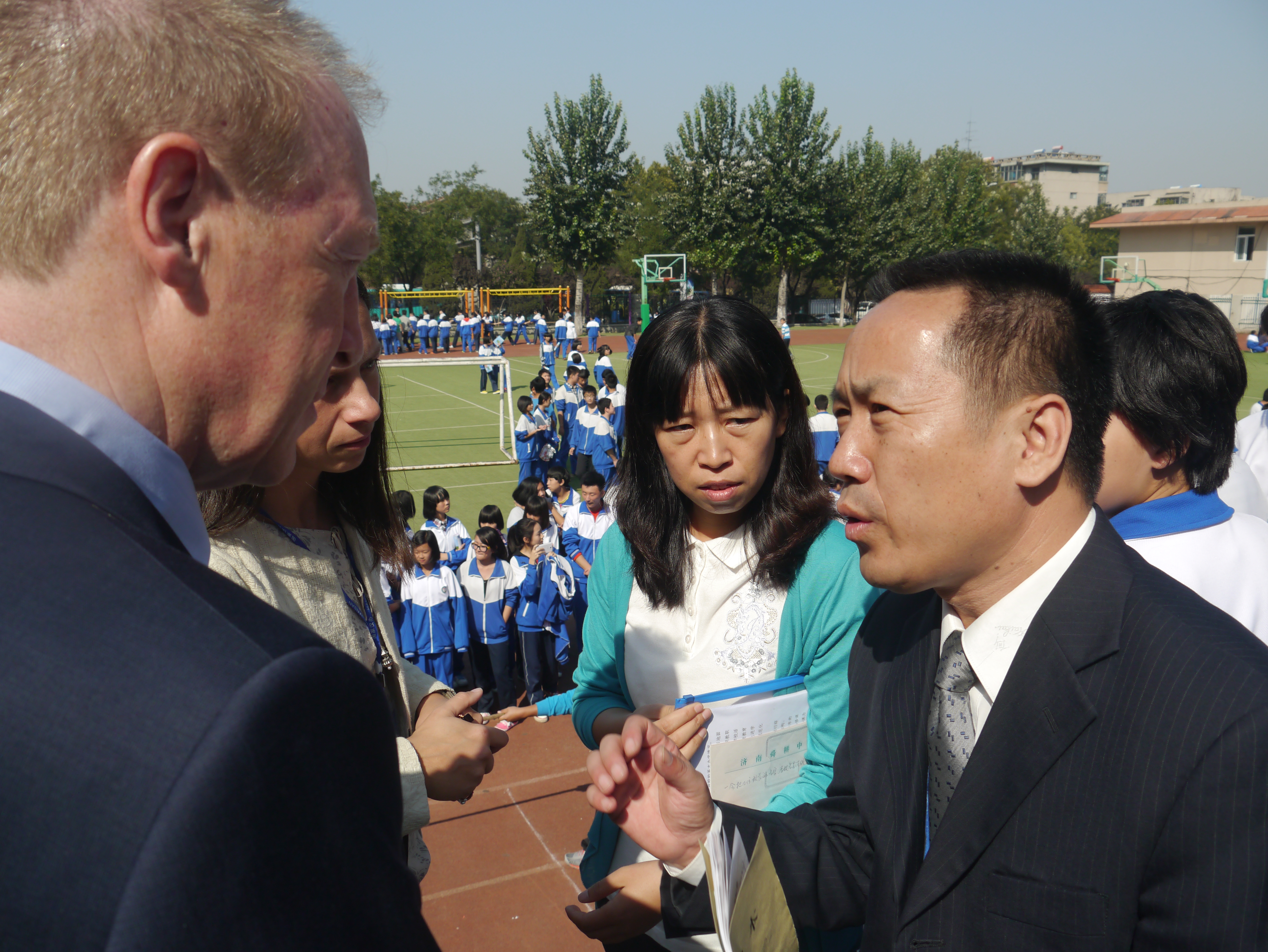
with Ceri James from CiLT Wales

and talking about Wales
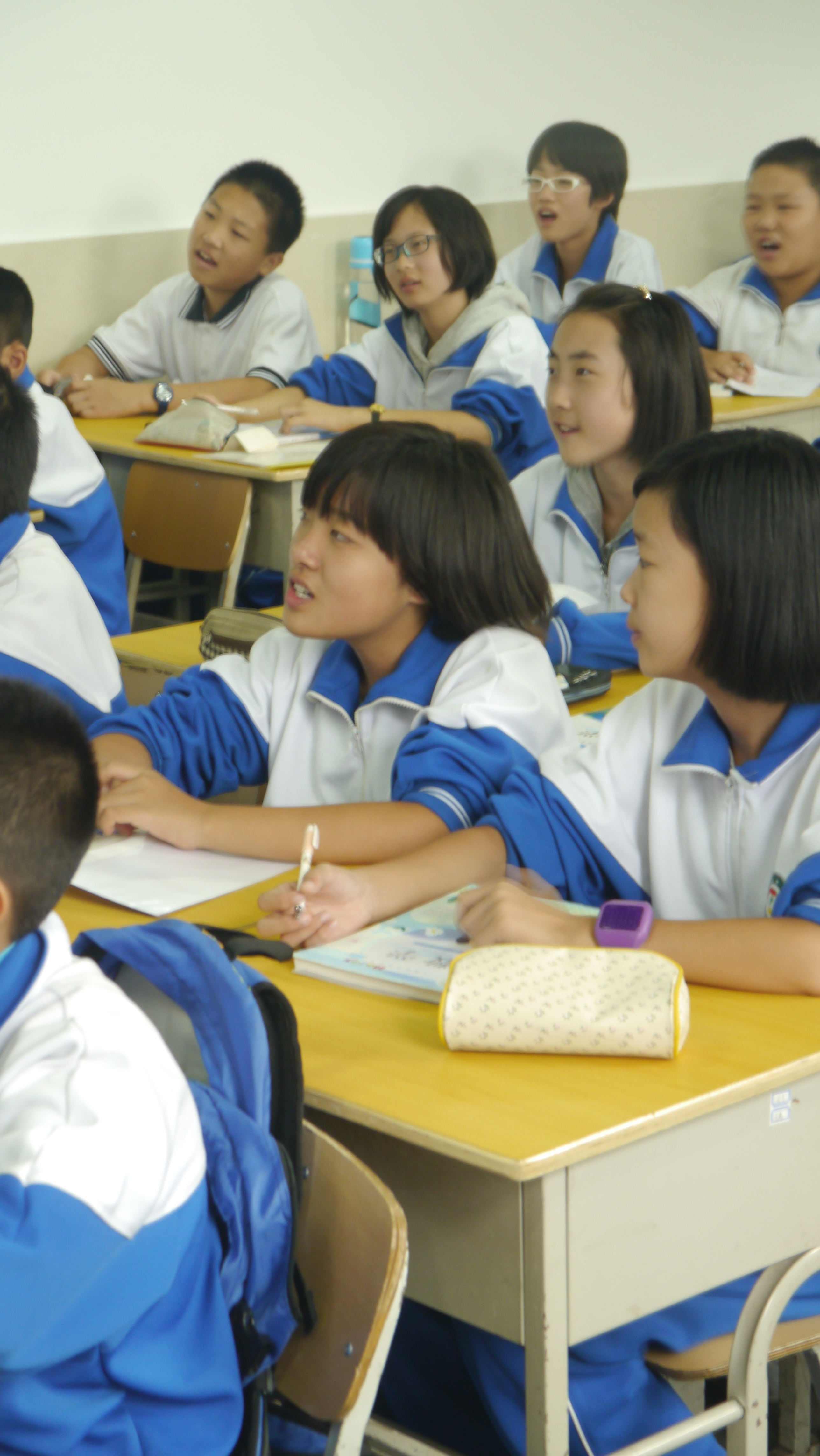
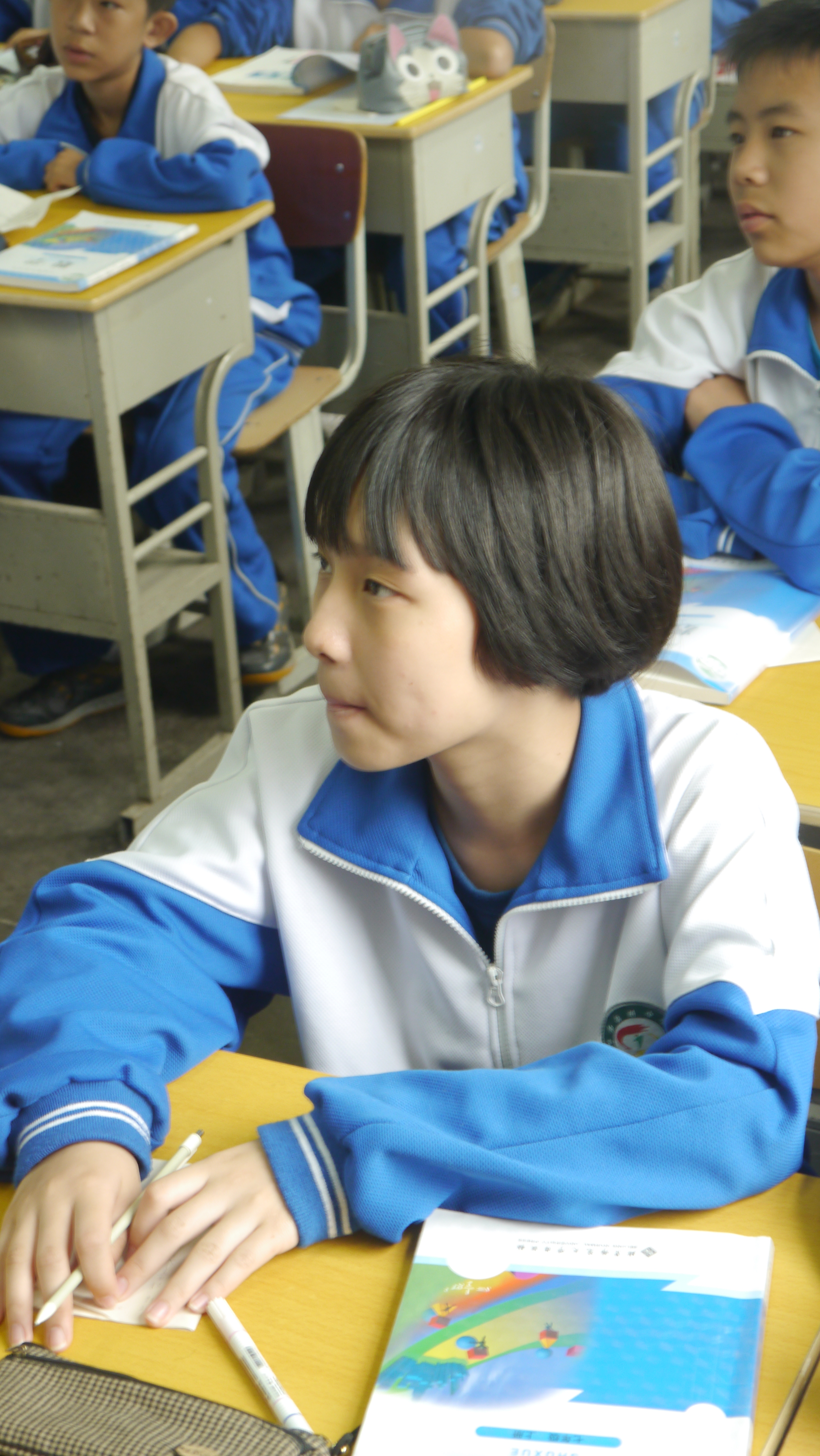
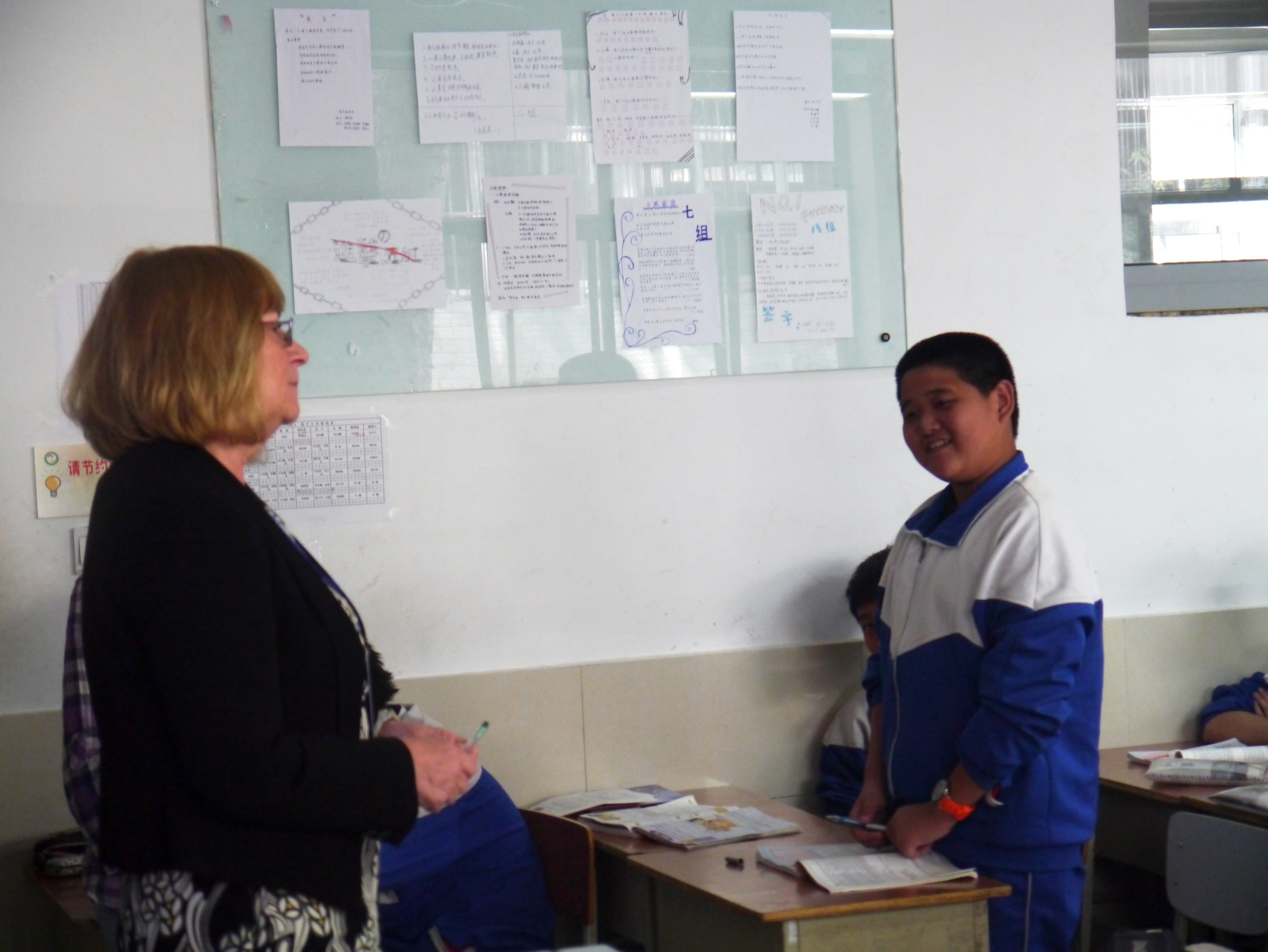
in the lesson
Physical well being is very important and students are encouraged to be out of buildings during any break and we saw lots of young people working at their sport practice with the same intensity as we say them working on academic practice in lessons.
There was also a 20 minute slot in the morning for students to do their eye exercises which is common in a lot of Chinese Schools.
 After school we were taken to dinner by a member of the Senior Management team and the two English Language Teachers that were attached to the us during the visit Ms Ho and Mr Wong. These two colleagues in particular helped make our visit to Jinan very special and were also happy to answer our questions and help us out.
The food was absolutely fantastic, and it took us a while to realise that the food would continue to arrive at the table if we continued to eat everything on the plates and if we stopped eating the food would stop arriving. Cross cultural issues abound with us being brought up to believe its polite eat everything on your plate and everything your host has cooked for you translating to your guests as not having provided enough for their guests to eat. We also learnt that the seating protocols for a classic Chinese Banquet were quite complex all about balancing the power around the table!.
All of the teachers on the journey really valued the time that spent in school and are hugely appreciative of The Confucius Institute and in my case the SSAT for the opportunity to take part in this fantastic journey.
China 1
Thinking through feedback! (Nudging)

 Reflecting on Education